Dušík, Johann Ladeslaus : Sonate für Klavier "Elegie harmonique sur la mort du Prince Louis Ferdinand de Prusse" fis-moll Op.61
Work Overview
Publication Year:1807
Instrumentation:Piano Solo
Genre:sonata
Total Playing Time:13 min 00 sec
Copyright:Public Domain
Additional Notes:全音楽譜出版社「チェコ・ピアノ作品集 第1巻」での邦題は【ソナタ「エレジー・ハーモニク」】となっている。
Commentary (1)
Author : Kawamata, Mako
Last Updated: March 6, 2019
[Open]
Author : Kawamata, Mako
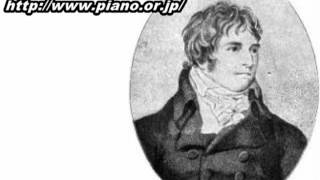
Jan Ladislav Dussek was born in Čáslav, Bohemia, in 1760 and died in Paris in 1812. Born to a musical father, he became familiar with the piano and organ from an early age. From his twenties, while teaching music as a piano instructor, he frequently held his own concerts and tours across Europe. He was one of the individuals who proposed extending the piano keyboard to six octaves and is also credited with devising the current performance style of placing the piano sideways on stage.
Composed between 1806 and 1807, Harmonic Elegy on the Death of His Royal Highness Prince Louis Ferdinand is one of Dussek's most well-known piano works. At the time, Dussek was teaching piano to Prince Ferdinand, his patron, and their relationship was closer than that of a mere teacher and student. Despite their close friendship, Prince Ferdinand tragically fell in the Battle of Saalfeld in 1806. As evidenced by Dussek's subsequent despondency, the Prince's death dealt him a significant emotional blow. The Harmonic Elegy on the Death of His Royal Highness Prince Louis Ferdinand expresses this sorrow in its entirety.
First Movement: F-sharp minor, 2/4 time – 2/2 time, Sonata form with introduction
How to read this chart
This formal diagram is read from left to right within each row, proceeding from the top row (1st row, 2nd row, etc.) downwards. Due to the structural commonalities of the piece, shared elements are vertically aligned, allowing for an immediate understanding of where each motif appears. The roles of the numbers and other elements in each row are as follows:
- Row 1: Section name
- Row 2: Measure numbers
- Row 3: Motif and motif's measure numbers
- Row 4: Key
- Row 5: Cadence (ped indicates a dominant pedal point)
The 枠外下部の「!」は、カデンツの中断など、聴き手の期待から意図的に逸れる箇所を表す。
[序奏] 冒頭2小節は荘重な葬いの鐘の音を模倣している。その響きに続いて現れるシンコペーション(= 内なる動揺)の旋律は、王子の死を悲しむドゥシークの心情の現れだろう。減七の和音が度々登 場する序奏部では、なかなか調が定まらず、そのことが、さらに彼の落ち着かない心情を強く表し、また聴き手の悲しみを誘うような効果を強めている。
[提示部] 第1主題は、序奏でも頻繁に使われていたシンコペーションを用いたモチーフから成る(a)。反対に、第2主題では縦のラインが強調された旋律が用いられている(b)。後者はオーケストラの響きを持ち、威厳を持って(con maestà)奏でられる。王子を連想させる軍人的性格を持ったモチーフだ。そのためか調もニ長調と明るくなっている。しかし、第80小節を境にカデンツが中断され、ロ短調の跳躍するモチーフが登場する(c)。後の展開部で発展するこのモチーフが3度繰り返されると、新たに装飾的な旋律が現れ(d)、それに続いて16分音符の分散和音(右手)による、流麗なモチーフが登場する(e)。
ここまでが第2主題で、第96小節からは展開部へと徐々に推移していく。悲しみとともに(con duolo)などと、楽譜にわざわざ表記されるまでもない程に悲痛な響きを持つ旋律(f)が奏でられた後、突如として長音階とそれに続く和音の重厚な響きが現れる(g)。わずか4小節で聴き手に ff→p→ffの波乱を経験させるが、この強弱の振れ幅の大きさも、情動の強い起伏を表している。
[展開部] 第2主題を用いて発展していく。提示部と比較すると(c’)の音域の広がりや、(e’’)の小節数の増加が目に付く。特に(e’’)は2度に渡って展開されており、提示部と比べて両者とも旋律的特徴が強まっている。時折響くその甘美な性格は皇太子に先立たれた者の回想だろうか。あえて調を明るくしたことで、悲痛な楽想とのコントラストがより一層引き立てられている。

[再現部] 再び第1主題が回想される。冒頭からここまでで制御できない心の動揺を露わにしてきたが、そ の波乱がここで1度落ち着く。第162小節のdolceには改めて王子を愛おしく思う気持ちが込められているのではないだろうか。第166小節からはコーダに入る。第168小節から4回繰り返される gis→fis→eisの悲痛な響きが印象的だ。燃えさかるように(con fuoco)最後の嘆きを強く訴えた後、6度目の(e)のモチーフがささやくように、常にいっそう消え入るように(sotto voce、 sempre più calando)奏でられ第一楽章が終わる。
【参考史料】
Jan, Ladislav, Dussek. SONATA ‘Èlègie Harmonique’ in F minor, Op. 61. Jeremy Eskenazi. England: Edition HH Ltd., 2012.
Grove Music Online, s.v. “Dussek family, ” by Howard Allen Craw , accessed May 28, 2015, https://doi.org/10.1093/gmo/9781561592630.article.44229
Movements (2)
Lento patetico - Tempo agitato
Total Performance Time: 7 min 30 sec
Tempo vivace e con fuoco, quasi Presto
Total Performance Time: 5 min 30 sec